
Customer Journey: Rethinking the Sales Funnel
You’ve seen the sales funnel from your very first marketing class. But do you really know where your customers are on their sales journey?

by John Anstey, Principal
We all know that familiar cone-shaped image of the sales funnel. While the specific stages can vary, most sales funnels include these core steps:
Awareness/Top of Funnel: This is where prospects first become aware of your senior living community, often through your advertising and marketing efforts.
Interest/Consideration/Middle of Funnel: Prospects show interest and begin to research, learning more about your community’s benefits and how it addresses their needs.
Decision/Evaluation: Prospects are in the process of making a choice and compare different options to find the best solution for their situation.
Action/Purchase/Bottom of Funnel: The prospect makes the decision to buy, completing the purchase, and moves into your community.
I’ve seen many versions of sales funnels on dry erase boards over the years. Some CRMs even show a funnel image on their dashboards to help you visualize where someone is in the sales process.
But does the sales funnel really give us an accurate picture of where the customer is in their journey? Is it really that simple? I have to argue that it’s not—especially in senior living sales. As we all know, this is a huge purchasing decision for seniors, where individuals are leaving their home (often one they’ve lived in for decades) that is filled with memories.
Complex sales processes take more time
The average sales cycle in senior living—from initial contact to move-in—is typically about 18 months. That’s a long time, and we’re always looking for ways to shorten this. There are few other industries that have such a long buying cycle. By comparison, the average new car shopper spends about 15 hours to make a car purchase, according to Money.com.
Studies show that the more complex the product is and the more expensive it is, consumers will need more time to make a buying decision. I think we all agree that purchasing senior living certainly falls into both of these categories. This is why it is so important to know where your prospects are in their sales journey.
Complex sales processes are not linear
In addition to understanding the extended timeframe most prospects need to reach a decision point, it’s also important to realize that very few prospects follow a linear, progressive path through the sales process.
Let’s consider a couple that came in for a Lunch-and-Learn event last month and you haven’t heard a peep from them. What’s going on? Well, maybe they left that meeting confused about your contract options and aren’t sure how best to move forward. Or maybe after the luncheon they took a previously planned extended vacation and are looking forward to booking a tour when they get home next week.
Both of these are possibilities, and each situation is driven by very different forces. In the first case—the confused couple—a smart drip campaign email could be just the ticket to getting them moving again. In the second, you may hear nothing until they return and schedule that tour.
The point is that prospects may move forward, then backward, then forward, then stall for a bit before coming to a decision point. It’s normal and natural, but there is a way to get a better understanding of the pathways your prospects take through your sales process.
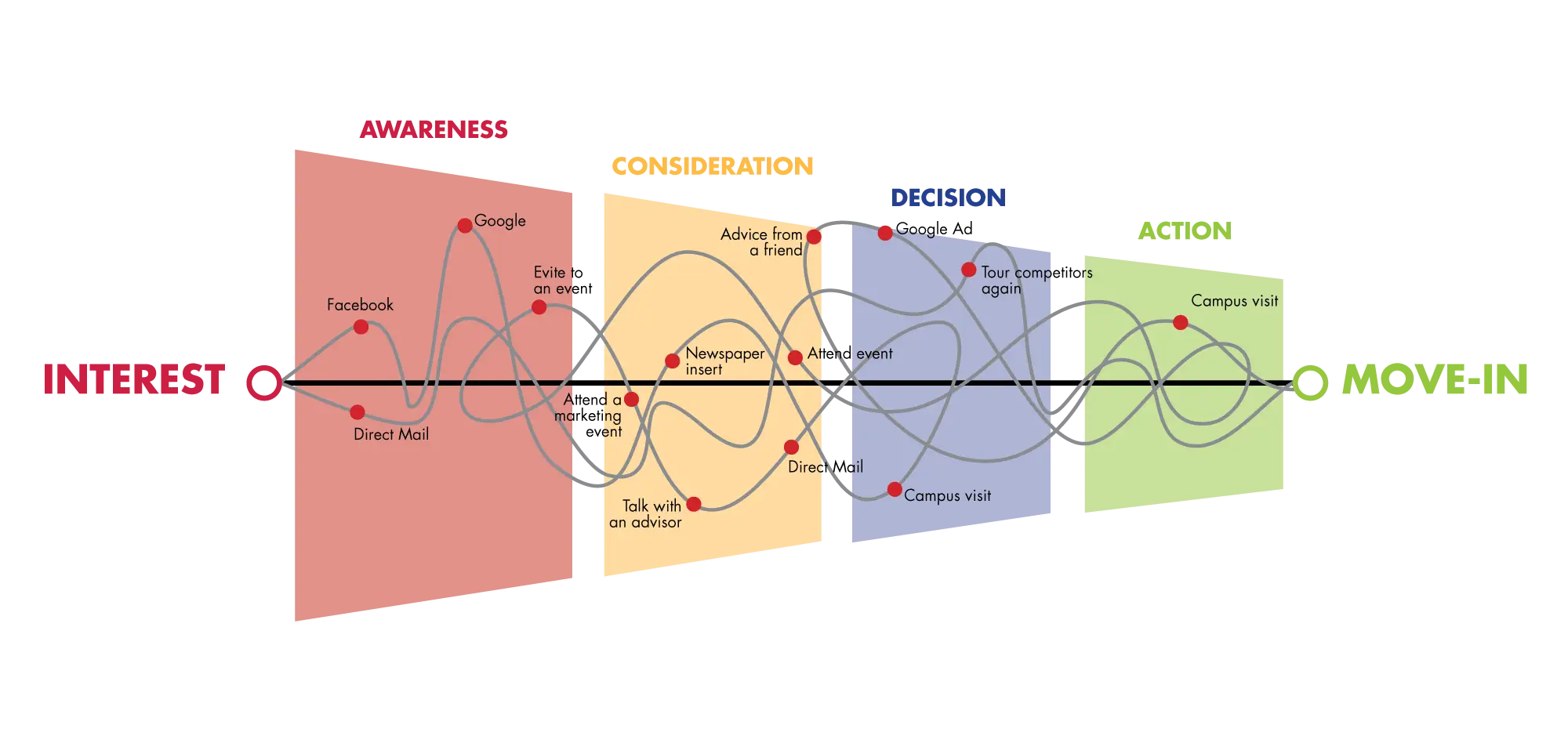
Learn through journey mapping
Journey mapping is a technique that allows you to place where a prospect is in the sales journey. While some CRMs show a “life of the lead,” that’s usually just a linear diagram that shows when the prospect first contacted you and all interactions since then. A journey map is different in that in addition to recording interactions, it adds an element of emotion that goes with each touchpoint.
Where are prospects stopping on their buying journey, and what are they feeling at these crucial moments? What might be preventing them from moving ahead? Review their verbatim comments that you captured in the notes section of the CRM. This will allow you to better understand what pain points your prospect is feeling.
With a properly completed journey map, you can better identify (and even anticipate) barriers that delay or prevent the prospect from moving forward, enabling you to more effectively address customer pain points and accelerate decision-making.
Smoothing out the journey
When you better understand what prospects are experiencing and feeling at various points in the sales process, you can begin to offer far more targeted marketing messages. Through marketing automation, you can create “drip” email campaigns to prospects—providing custom content over a series of weeks or months, over time tackling middle- or later-stage topics. Digital remarketing ads can be created to speak directly to prospects who visit the community’s website. Direct sales team outreach—when appropriate—can make a huge difference in making the prospect feel comfortable moving forward.
“When you better understand what prospects are experiencing and feeling at various points in the sales process, you can begin to offer far more targeted marketing messages.”
Patience and understanding the journey make a difference
We would all love to have a line of people at our doors ready to buy today. But the old “what will it take to get you in this car today, sir” approach rarely works with such an expensive and impactful—and often lifelong—decision like choosing a senior living community.
And every individual or couple is a full life of influences affecting them—family pressures, financial pressures, health issues, etc. They’re not spending every moment of every day on this decision process. So be patient. Know that two steps up and one step back is a normal experience, and it doesn’t mean anything is wrong. Take a deeper look at your prospect experience with journey mapping so you can better tailor your marketing messaging to deliver more specific information at just the right time to spark movement.

About Anstey Hodge
Founded in 2003 in Roanoke, Virginia, Anstey Hodge is a full-service marketing agency specializing in senior living. Our team is made up of marketing experts with deep experience in strategic marketing planning, brand development, digital advertising, SEO/AIO, creative campaigns, website development & interactive tools, and more. Anstey Hodge is a certified Google partner agency.
This article is just one in a series of articles sharing some of our lessons learned over the past 20+ years as leaders in the industry.